
Best cortisol supplements are often ranked as if every ingredient is solving the same problem. Human trials tell a narrower story.
Some ingredients changed serum or salivary cortisol in stressed adults. Others changed perceived stress, fatigue, sleep, inflammation, or metabolic markers. Those outcomes matter, and each one answers a different question.
A supplement label also cannot separate everyday overload from Cushing syndrome, adrenal insufficiency, thyroid disease, iron deficiency, or a sleep disorder. Persistent or severe symptoms need clinical evaluation.
Do cortisol supplements work?
Some cortisol supplements have human evidence, and the best match depends on the outcome you want to change. Standardized ashwagandha has the most consistent evidence for lowering measured cortisol in stressed adults. Rhodiola, a combined phosphatidylserine/phosphatidic acid formula, vitamin C, and omega-3 have narrower cortisol findings. Magnesium, L-theanine, and myo-inositol mainly support adjacent outcomes.
No over-the-counter supplement diagnoses or treats Cushing syndrome, adrenal insufficiency, or another endocrine disorder. Symptoms that are severe, persistent, or unusual belong in a clinician’s office.
What is a cortisol supplement?
A cortisol supplement is a dietary supplement marketed to support the stress response or influence cortisol-related outcomes. These products contain nutrients, fatty acids, or botanical extracts rather than cortisol itself.
Prescription hydrocortisone is a glucocorticoid medicine used to replace cortisol in conditions such as adrenal insufficiency. It belongs to a different treatment category and requires medical supervision.
How we graded the evidence
We gave the most weight to systematic reviews and randomized human trials that measured serum or salivary cortisol directly. Studies measuring perceived stress, fatigue, sleep, inflammation, insulin, or androgen markers were classified as indirect or adjacent evidence.
We also considered sample size, study length, replication, the exact extract or formulation used, and whether the result applied to the full study group or a smaller subgroup.
Cortisol is supposed to rise and fall
Cortisol follows a daily rhythm. Levels rise around waking, decline across the day, and reach their lowest point during the night. Short spikes help your body respond to a demanding event.
A healthy stress response returns toward baseline after the demand passes. The deeper guide cortisol is not the enemy explains why normal cortisol activity supports energy, blood pressure, glucose availability, and immune signaling.
Sleep timing, movement, morning light, caffeine, and meal patterns shape the same system. The daily habits that raise or lower cortisol deserve attention before another bottle is added.
How do you know whether your cortisol is actually high?
Symptoms alone cannot confirm high cortisol. Fatigue, poor sleep, brain fog, cravings, and central weight gain can also appear with thyroid conditions, low iron, perimenopause, medication effects, or a sleep disorder.
One morning blood result also gives a limited view because cortisol changes by time of day and responds to sleep, illness, medication, and acute stress. The guide to normal cortisol levels explains how timing and test type change the interpretation.
A symptom list is a reason to investigate. Clinical testing supplies the diagnosis.
When symptoms deserve a clinician
Cushing syndrome can cause rapid weight gain around the face and trunk, purple stretch marks, muscle weakness, and skin that bruises easily.
Adrenal insufficiency involves inadequate cortisol production and can cause severe fatigue, low blood pressure, abdominal symptoms, salt craving, and unintended weight loss. A clinician should assess either pattern before supplements are started.
Cortisol supplement evidence at a glance
Supplements with direct cortisol evidence
Ashwagandha
Ashwagandha has the strongest overall human evidence in this group, though the size of the effect and the stress-score findings vary across reviews.
A 2024 systematic review and meta-analysis of nine randomized trials covering 558 participants found lower perceived stress scores and lower serum cortisol with ashwagandha formulations. The review also found meaningful differences between extracts, doses, populations, and study methods.
Study snapshot
- Population: 64 adults with chronic stress
- Form and dose: A high-concentration full-spectrum root extract, 300 mg twice daily
- Duration: 60 days
- Measured outcome: Stress questionnaires and serum cortisol improved compared with placebo
- Limit: Single-center trial, short duration, and one specific extract
The NCCIH ashwagandha safety review advises avoidance during pregnancy and breastfeeding and caution with thyroid or autoimmune conditions, surgery, sedatives, diabetes medicines, blood pressure medicines, and thyroid hormone. Rare liver injury reports have also been documented.
Match the label to the extract and daily dose used in the study you are relying on. “Ashwagandha root powder” and a standardized extract are not interchangeable.
Rhodiola rosea
Rhodiola has a narrower evidence base centered on stress-related fatigue and the cortisol response to waking.
Study snapshot
- Population: 60 adults aged 20 to 55 with stress-related fatigue
- Form and dose: Standardized SHR-5 Rhodiola rosea extract, 576 mg/day
- Duration: 28 days
- Measured outcome: Burnout symptoms, attention measures, and cortisol response to awakening
- Limit: Small trial using a specific extract in a defined fatigue population
The randomized placebo-controlled Rhodiola trial supports an anti-fatigue effect and a change in awakening cortisol response. It does not establish a broad reduction in daily cortisol for the general population.
Phosphatidylserine and phosphatidic acid
The best-cited cortisol trial used phosphatidylserine together with phosphatidic acid. Results from that combination should stay attached to the combined formula.
Study snapshot
- Population: 75 healthy adult men, analyzed by low and high chronic-stress subgroups
- Form and dose: 200 mg PS + 200 mg PA/day, 400 mg PS + 400 mg PA/day, or placebo
- Duration: 42 days
- Measured outcome: ACTH, salivary cortisol, and serum cortisol after the Trier Social Stress Test
- Limit: The higher dose changed endocrine stress responses in the high-stress subgroup; the lower dose showed no significant effect
In the randomized PS/PA study, the 400/400 mg dose normalized ACTH and cortisol reactivity in men with high chronic stress. The result cannot be assigned to phosphatidylserine alone.
Vitamin C
Vitamin C has evidence for faster recovery after an acute laboratory stressor. The trial did not show a smaller total cortisol response.
Study snapshot
- Population: 120 healthy young adults before study exclusions
- Form and dose: Sustained-release vitamin C, 1,000 mg three times daily
- Duration: 14 days
- Measured outcome: Blood pressure, subjective stress, and salivary cortisol recovery after the Trier Social Stress Test
- Limit: The 3,000 mg/day dose exceeded the current adult tolerable upper intake level
The vitamin C stress trial found faster salivary cortisol recovery after the stress test. The NIH Office of Dietary Supplements vitamin C fact sheet sets the adult upper limit at 2,000 mg/day from food and supplements combined. Higher intake can cause diarrhea, nausea, and abdominal cramps, and it can worsen iron overload in people with hemochromatosis.
The study dose belongs in the evidence summary, not on a routine-use recommendation.
Omega-3 fatty acids
Omega-3 deserves a place in the comparison because one controlled trial measured cortisol during acute stress. The evidence is promising and still limited to a specific study setting.
Study snapshot
- Population: 138 sedentary, overweight, middle-aged adults, including 93 women
- Form and dose: 1.25 g/day or 2.5 g/day of omega-3, compared with placebo
- Duration: 4 months
- Measured outcome: Cortisol, inflammation, and cellular-aging biomarkers during a laboratory speech stressor
- Limit: Single population and acute-stress protocol; the trial was not designed to treat a cortisol disorder
In the 2021 randomized omega-3 trial, the 2.5 g/day group had 19% lower overall cortisol during the stressor than placebo. The finding supports further research and does not establish routine omega-3 supplementation as a treatment for high cortisol.
Supplements with indirect or adjacent evidence
Magnesium
Magnesium appears most useful when low intake or low magnesium status is part of the stress picture. Human trials mainly measure perceived stress and magnesium status rather than cortisol itself.
The practical question is whether a deficiency or low intake is present. Higher supplemental doses can cause diarrhea and may interfere with the absorption of some antibiotics and bisphosphonates, so medication timing and total daily intake should be reviewed with a clinician or pharmacist.
L-theanine
L-theanine has better evidence for perceived calm than for lowering cortisol.
Study snapshot
- Population: 30 healthy adults with moderate stress
- Form and dose: AlphaWave L-theanine, 400 mg/day
- Duration: 28 days
- Measured outcome: Perceived stress, mood, sleep, cognition, and salivary cortisol
- Limit: Small, product-specific trial; salivary cortisol did not differ significantly from placebo at day 28
The 2024 randomized L-theanine trial found an improvement in perceived stress scores. The cortisol result stayed neutral, which keeps L-theanine in the indirect evidence tier.
Myo-inositol
Myo-inositol research in PCOS focuses on insulin, ovulation, and androgen-related outcomes. Cortisol is not the target outcome, and the quality of evidence varies across doses and formulations.
The ingredient belongs in this article because stress, insulin resistance, cravings, and androgen symptoms can overlap in the same reader. Its evidence remains adjacent to cortisol. The guide does myo-inositol cause weight gain covers the weight and metabolic questions in more detail.
Which cortisol supplement fits your goal?
Choose the ingredient whose studied outcome matches the problem you are trying to change.
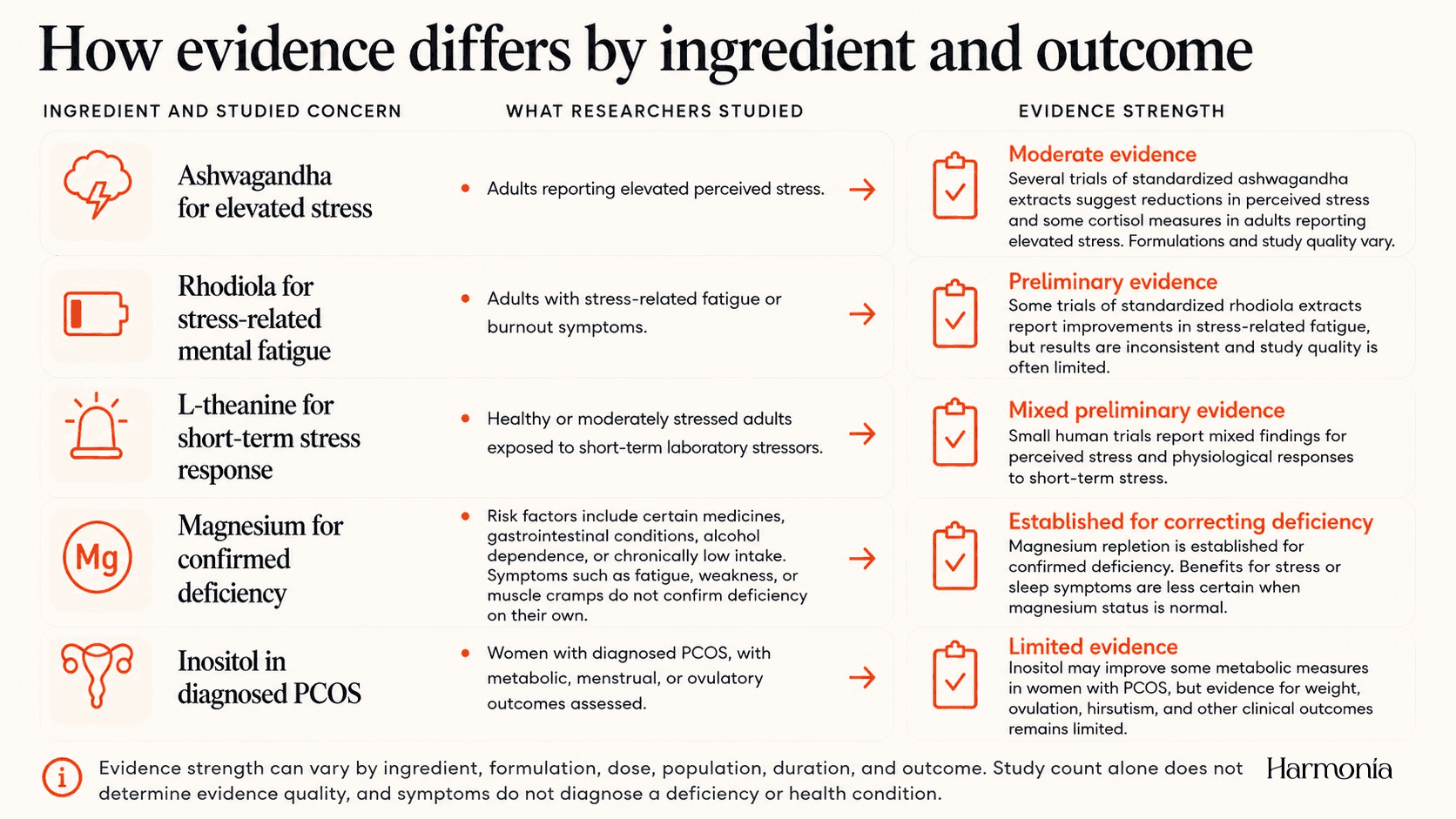
How to choose a legitimate cortisol supplement
A legitimate cortisol supplement should disclose every active dose, identify the exact extract or formulation, and provide verifiable quality testing.
- Exact amounts: Every active ingredient should have its own milligram or gram amount.
- Study-matched form: Look for the same standardized extract or combined formulation used in the cited research.
- Elemental mineral amount: Magnesium labels should state elemental magnesium, since compound weight is a different number.
- Independent testing: A certificate or recognized third-party program is more useful than an unsupported “lab tested” claim.
- Allergen and source details: Check soy, fish, algae, and botanical source information when it applies.
- No hidden proprietary blend: A total blend weight cannot tell you whether any ingredient reaches a studied dose.
Dietary supplements reach the market without preapproval for safety or effectiveness. Label transparency, study-matched forms, and independent verification therefore carry more weight when you compare products.
Timing and how long results take
Morning or night: when should you take it?
No universal morning-or-night schedule has been established across cortisol supplements. Use the study formulation, product directions, tolerability, and medication timing to build a consistent schedule.
Medication spacing can matter more than the clock. Magnesium may need to be separated from tetracycline or quinolone antibiotics and oral bisphosphonates. NCCIH also lists possible ashwagandha interactions with sedatives, thyroid hormone, diabetes medicines, blood pressure medicines, immunosuppressants, and anticonvulsants.
Rhodiola, L-theanine, omega-3, and myo-inositol trials used product-specific schedules. A claim that one time of day “controls cortisol” needs direct evidence from that product and regimen.
How long do cortisol supplements take to work?
Most of the relevant trials measured outcomes after several weeks. Ashwagandha studies in the systematic review lasted 30 to 112 days, L-theanine and rhodiola lasted 28 days, the PS/PA trial lasted 42 days, and the omega-3 trial lasted 4 months.
The vitamin C study was shorter at 14 days and tested recovery from a laboratory stressor at a dose above the adult upper limit. A same-day feeling of calm is a personal response and does not show that baseline cortisol has changed.
Judge the product against the outcome the trial measured. A sleep score, a stress questionnaire, and a cortisol assay answer different questions.
Side effects, interactions, and who should check with a clinician
Each ingredient carries a different safety profile. A single “natural stress support” disclaimer does not cover the medication, pregnancy, thyroid, allergy, kidney, or bleeding considerations in this list.
Higher-dose omega-3 can interact with anticoagulants, so medication review matters.
Pregnancy, breastfeeding, thyroid disease, kidney disease, hormone therapy, blood pressure or blood sugar medication, anticoagulants, sedatives, and fertility treatment all justify a clinician or pharmacist check before use.
Where Harmonia fits
Reading the research is one thing. Choosing a supplement that brings those ingredients together in meaningful amounts is another.
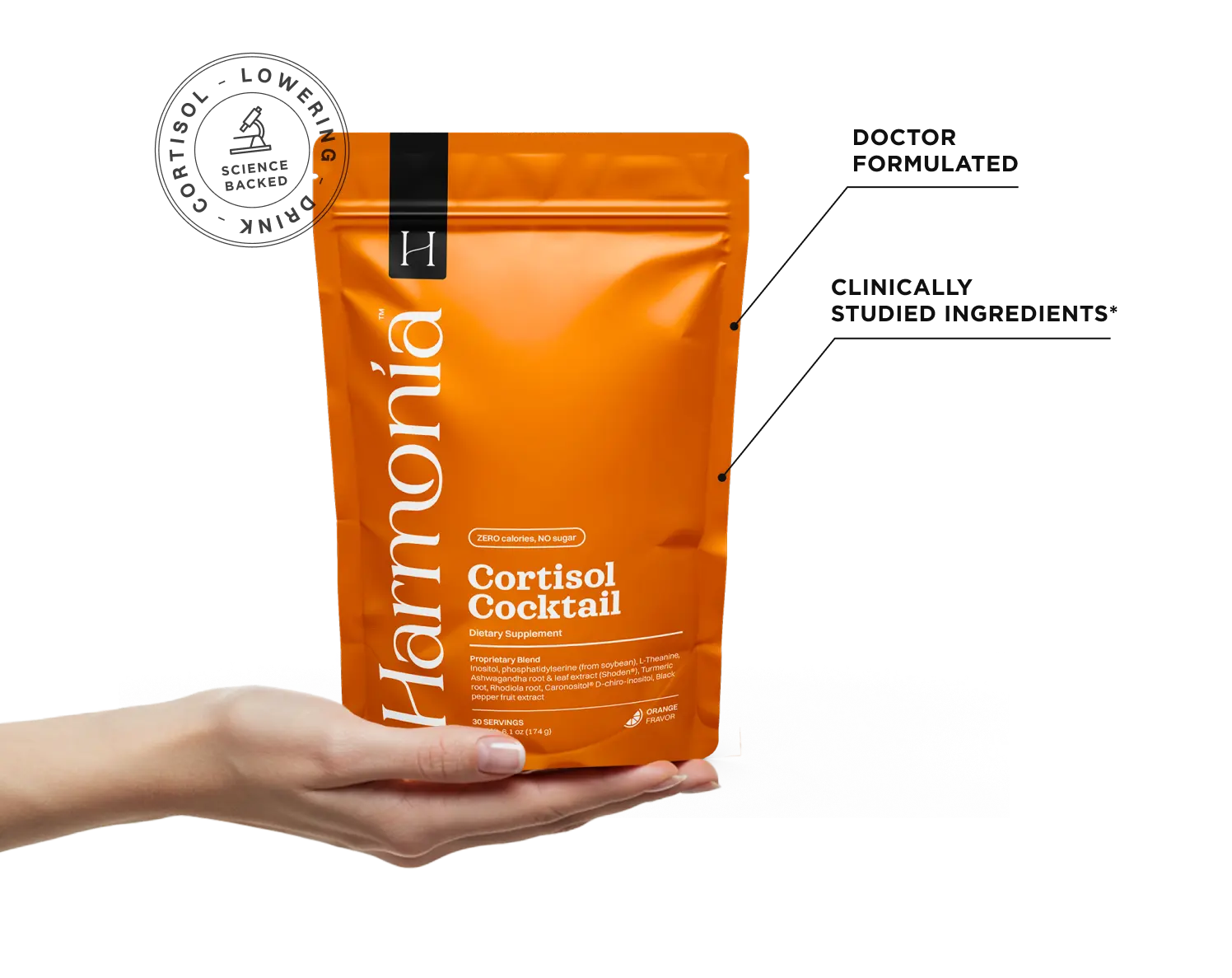
The Harmonia Cortisol Cocktail was designed around the ingredients with the strongest human evidence for supporting everyday stress. It combines ashwagandha, rhodiola rosea, L-theanine, myo-inositol, magnesium, vitamin C, and key B vitamins into one convenient daily formula, so you don't need to build your own stack from multiple products.
Rather than relying on a single ingredient, Harmonia supports several aspects of the stress response at the same time. Ashwagandha provides the strongest evidence for perceived stress and selected cortisol outcomes, while rhodiola supports stress-related fatigue, L-theanine promotes calm, myo-inositol supports metabolic health, and magnesium and vitamins help fill nutritional gaps that can influence energy and resilience.
Like every supplement discussed in this guide, Harmonia should be viewed within the limits of the available evidence. It is designed to support healthy stress management and general wellness—not to diagnose, treat, or replace medical care for adrenal insufficiency, Cushing syndrome, thyroid disease, or other endocrine conditions.
_11zon.jpeg)
The bottom line
Standardized ashwagandha has the most consistent evidence for lowering measured cortisol in stressed adults. Rhodiola, a combined PS/PA formula, vitamin C, and omega-3 have narrower findings tied to specific stress tests, populations, or doses. Magnesium, L-theanine, and myo-inositol address related outcomes rather than cortisol itself.
Match the ingredient to the outcome, use the exact formulation evidence supports, and check the safety details before starting. Persistent symptoms, unusual physical signs, or suspected hormone disease need clinical testing.
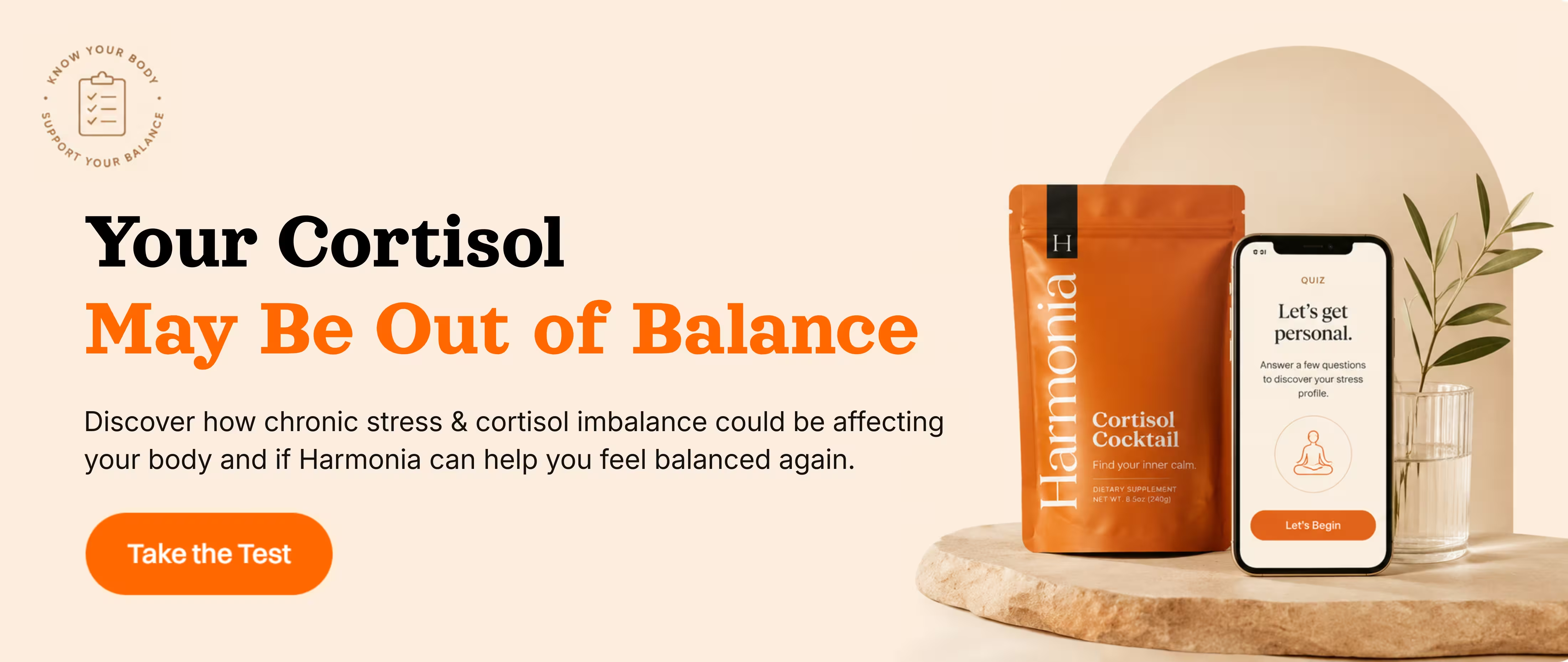
If stress keeps showing up across sleep, energy, cravings, or hormone symptoms, you can take the quiz to see whether the Harmonia Cortisol Cocktail fits what you are experiencing right now.
References
- Arumugam, V., et al. (2024). Effects of ashwagandha (Withania somnifera) on stress and anxiety: A systematic review and meta-analysis. Explore, 20(6), 103062. Link
- National Center for Complementary and Integrative Health. (2023). Ashwagandha: Usefulness and safety. Accessed July 21, 2026. Link
- Olsson, E. M., von Schéele, B., & Panossian, A. G. (2009). A randomised, double-blind, placebo-controlled, parallel-group study of the standardised extract SHR-5 of Rhodiola rosea in subjects with stress-related fatigue. Planta Medica, 75(2), 105–112. Link
- Hellhammer, J., Vogt, D., Franz, N., Freitas, U., & Rutenberg, D. (2014). A soy-based phosphatidylserine/phosphatidic acid complex normalizes HPA-axis stress reactivity in chronically stressed male subjects: A randomized, placebo-controlled study. Lipids in Health and Disease, 13, 121. Link
- Brody, S., Preut, R., Schommer, K., & Schürmeyer, T. H. (2002). A randomized controlled trial of high-dose ascorbic acid for reduction of blood pressure, cortisol, and subjective responses to psychological stress. Psychopharmacology, 159(3), 319–324. Link
- NIH Office of Dietary Supplements. Vitamin C: Fact sheet for health professionals. Link
- Madison, A. A., et al. (2021). Omega-3 supplementation and stress reactivity of cellular aging biomarkers: An ancillary substudy of a randomized controlled trial in midlife adults. Molecular Psychiatry, 26(7), 3034–3042. Link
- Moulin, M., Crowley, D. C., Xiong, L., Guthrie, N., & Lewis, E. D. (2024). Safety and efficacy of AlphaWave L-theanine supplementation for 28 days in healthy adults with moderate stress. Neurology and Therapy, 13(4), 1135–1153. Link
- National Institute of Diabetes and Digestive and Kidney Diseases. Cushing’s syndrome.. Link
- National Institute of Diabetes and Digestive and Kidney Diseases. Adrenal insufficiency and Addison’s disease. Link